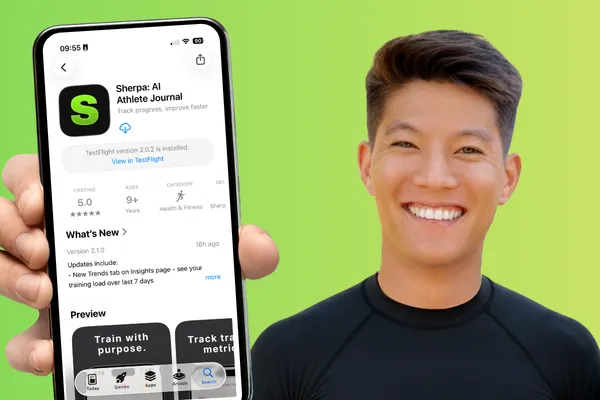
Josh Lu (Sherpa app) Interview
Josh Lu is co-founder of Sherpa Journal, an app utilising the science of journaling for sport performance and harnessing the power of AI to help athletes gain insight into their training. He is also co-host of the podcast 1-800-BJJ-HELP with Less Impressed More Involved YouTuber and founder of the Outlier Database, Jake Luigi.
Am I right in thinking you started your podcast very early on in your Jiu Jitsu journey?
Yes, we started it super early, less than 50 classes in but I want to say maybe even around 10 classes!
It was Jake. I was super lucky because I found him through a podcast of a similar format but a different topic and I was like “hey, you want to just do this one together?” because I already talked to him on the phone about Jiu Jitsu and stuff and he was working really hard on his YouTube channel but it hadn't taken off yet. So I luckily started the podcast with him at that time and then kind of rode his coattails ever since.
So then at what point did the app come about as an idea?
Yeah, so probably a year into the podcast. I had already been journaling in my Evernote app on my phone and I had done that for previous hobbies as well.
Sorry to interrupt, I'm going to come back to this but were you an archer? Is that right, Archery?
That’s right. Generally, every archery session before and after, you know, you miss some every now and then but I tried to be consistent and then actually, before that, I even wrote notes for rock climbing, like the right RPE and duration and everything and that was in Evernote.
So then you start Jiu Jitsu and you're doing all your notes for Jiu Jitsu in Evernote, as previously, and then?
And then I thought “Hey maybe I'll come out with a Jiu Jitsu notebook”, like a physical journal thing and then I was working on that for a bit, never did anything with that. And then Chat GPT came out and I started using it a lot and then I was like “Oh let me just throw all my notes in there and tell it to summarise or give me my three biggest strengths and three weaknesses”, or something like that and then I read it and I was like “I knew my guard sucks!”
And so then I sent it to a friend of mine who was competing in Pickleball and I asked “do you journal for Pickleball?” He'd actually just started two weeks before! He sent me his notes, I did the same thing and he said “let's co-found this together, this should be an app”.
So your partner for the app is a Pickleball guy?
He was like “I'll co-found and invest with you and walk in another co-founder who will be an engineer”. So he actually gave us a bit of investment money. But yeah, so the three of us co-founded it. Since then, he’s become more just an investor. And then the original engineer co-founder got very busy with work. So now I have a new co-founder, as of a year ago.
And does he play a sport?
Yeah, so I met him through Jiu Jitsu. He was watching Jake's YouTube channel and found the podcast, heard I was moving to San Diego, messaged me. We started training together. We started doing eco together, he was in my CLA garage experiment, we were both figuring it out. He was a purple belt at the time and yeah, now he's the one of the owners of Corvus with Andris.
Oh cool! At first I think you meant it to be a kind of general athlete journal but it seems more Jiu Jitsu oriented now.
That's a really good observation. It started out pretty big vision and I think now we are going to niche down and focus on Jiu Jitsu first. And you know, we're not going to say no if anyone wants to use it. There's some people using it for investing and I think there's a surgeon that uses it. So it's for anyone who wants to reflect, but now we're starting to put some of the athlete stuff in there.
So do you have a background in tech? What is your day job?
I have seven years of sales experience and then I went into marketing for about seven years as well and most of that experience was at early stage startup software companies. So just been around tech, yeah. I was never technical and I still don't consider myself technical but I was in the room with technical people.
So how's the process of building an app been? As you imagined it would be? Harder, easier, or just different?
The first year was a lot. Actually, the first two years were a lot harder than I thought it was going to be. I think because I'm not technical, I was like, “Here, I have these ideas, just make it work!” And no, it's a lot more complicated. So that was one unexpected thing, it is way more complex how all this data and all this stuff is wired and to keep it safe and secure and maintainable and reusable and everything.
The second biggest challenge was just dealing with kind of bootstrapping this. It's our nights and weekends side project, amongst multiple people and some people like my co-founder now, has a family. He has Corvus. He's got a day job. I've got a day job. It doesn't always line up that we're both like, oh, we have time to work on this together. So just the ebbs and flows of working with with different priorities.
And the decision to not try to raise more money and then quit our jobs and work full time, that'd be cleaner but then you have that investor pressure. You got to hit X number, monetize as fast as you can grow. So we thought, let's pick the maybe slower route but we get to make the call on how we want to build this thing. Without any pressure to put ads in there or whatever. We could do right by what we think and hopefully one day make money but take the journey to be our own.
You mentioned Evernote before and that’s an app which will convert written text via a photo, into typed text. Do you think that’s a potential thing that your app might have at some point?
Yeah, Mike and I have talked about this because even now I have a handwritten journal and I almost switched to an AI based journal for just life stuff but then I don't know, I still like that handwriting for my life. If I had a fight with my girlfriend last night, I don't know if I want to just type it out there into some AI database.
I still use notebooks but I do different things in different places. In the app, I'll be quite succinct and I like the prompts and daily check-in. But then I have notebooks where I'll write more detail on my training intentions, though not as often, so the app's really good for quick reflections.
Yeah, it's like, which tool is the right tool for the job? And so with the physical one, I've been doing these morning pages practice from The Artist’s Way book. And she describes the whole goal of those morning pages is just get it done. It's just, write it all down. You know, I guess the idea is just to do it, just to get the thoughts out.
And it's even fine if I throw them all away. Versus the Sherpa app which is more pointed, like, how was my sleep? I really want to give it a number. Like, was it a six? Was it a five? And it's like the tool is more specific I guess.
How often do you delve into new studies or studies you haven't yet read, in order to help shape the app more?
Yeah, I think last year I dove in a lot more versus recently but I use Chat GPTsdeep research to find all the studies. And I was like, “just give me a rating on which ones are the strongest studies”, you know, because it can get to a pretty crazy out there with Psychology Today, random blogs, manifestation type stuff. So yeah, that was my approach. And then I went and started reading the individual studies but with my attention span, they're a little hard to get through, so I would rely on summarization sometimes. But then if I'm going to write a blog post about it, I will read it deeply to make sure these are the exact things.
A lot of the studies I looked at were meta analyses. I think the first original study of journaling and its effect on us was about expressive writing and it related to people healing faster from injuries, mental health and wellbeing, those types of things. And then later, they started niching down a little bit more into athletics and injury recovery, engagement with recovery processes, dealing with the challenging emotions that come from injury. I think that kind of relates to the expressive writing stuff and those were some really strong findings, goal setting and accountability and progress checking.
And then what are the other big topics? Oh, dealing with the anxiety or just emotions around high pressure type of situations.
How do you convince people that this is a good thing to do in the first place. Not just “you’re journaling, use my app” but also “journal in the first place” because most students don't do it.
I think everyone's mind is so different. You and I are pretty similar. Like, there's a part of it that I think, for some portion of athletes, there's probably like a pie chart and there's a slice where there are the people who are more verbal, or they think a lot about these things. They like the conceptual side and they like to nerd out. And not only do they enjoy it, it’s just maybe more how they're wired.
And then there's other people who maybe could try it and see if it would help but there's a spectrum there of who it maybe comes more naturally to, versus others.
I do think at the core of it, being intentional and reflecting, whether it's writing, thinking or talking with a friend, is what's really helpful and however you do that, whenever you do that, the more the better. To be intentional and to reflect. Maybe not all the time, but yeah, I think it's helpful. And I'm hoping to make Sherpa more accessible and easy across that spectrum of different people.
There's so much of life we do on autopilot. You just kind of go through it and you show up every day, same routine, everything and even if their intention is unconscious, they don't even know why they're going to Jiu Jitsu, but they want to just get a sweat on and have fun, then I think it is helpful to be clear on that.
I feel also there's this balance between focusing on improvement versus enjoyment and sometimes they overlap and that's awesome. Like the thing you “should” work on, you also enjoy working on.
In a recent podcast you mentioned the third space thing, where a lot of people are just using their Jiu Jitsu gym as a place to socialise away from home and work. There is a difference between enjoyment and improvement but the better you get, the more enjoyable it is.
That's how I feel too. I feel like making progress is an awesome feeling and that's probably a big reason I like Jiu Jitsu, because you can viscerally feel the progress that you're making. Not all the time but mostly.
That's where the reflection comes in. Because you have the intentions, you think you know what you want. Well, first maybe it's like you don't even know what you want, you're on autopilot. Then maybe you know what you want, or you think you know what you want. Then, are you getting what you want? And that's where the reflection comes in. It's like, is this fulfilling what I want? Am I improving the way I want? Why or why not? Am I enjoying it the way I want? Why or why not? And yeah, I think it just hopefully allows you to engage in things that align with what you really want.
Like right now I'm not competing because I hurt my neck, everyone's competing and I'm having FOMO but I'm like, wait, why do I have to compete? Should I compete and then have four months of neck pain? Or maybe I could fix my neck first.
Also I would always just go to the gym, train, head out right away, just in a rush to go back home. Then the other day I sat around for a bit and had this great conversation with someone for an hour. And after, in my reflection, I was like, what went well? It was making a new friend! Like I forgot that's also a great piece of Jiu Jitsu but I’d forgotten that intention. So then I told my girlfriend when I got home “Hey, every now and then I think I'm just going to not have a specific time I need to come back from Jiu Jitsu. Just see if I want to use that third space and hang out”.
For sure. And if you practice questioning what you want, reflecting on it and changing your strategy for how to get there, you can then apply that to the rest of your life, steer towards better goals, feel a lot more fulfilled and live more purposefully.
Yeah okay, this is a great point. There's a book called the Top Five Regrets of the Dying. It's a little morbid. But one of them is “I wish I had lived a life according to what I wanted and not what others had wanted for me”.
I grew up in an Asian household and a lot of my friends too, doctors, lawyers, you know, you end up living a life for your parents, not one for yourself. And it's just a deeper topic of like, how can I be aligned with my internal vision versus external pressure. And that can be as big as your life calling and job and career and purpose. Or that could be as small as the instructor is teaching arm bars today and you don't want to do that right now, you've already learned that and want to learn something else. So yeah, it could be big or small, but it's that tension between internal vision and external pressure.
And one way to get there is to clarify all that. Being mindful and intentional and reflecting and having these kinds of conversations versus just “Oh, this is the way things are. Okay. Don't question it”.
Well, that's a good segue because I feel there’s a link between goal setting, reflection and journaling, and Eco and CLA. Intention seems to be the word that links them. What are your thoughts?
I do think intention is a big one. And actually reflection is too.
When Greg kind of yelled at everybody and made us reflect “What are you getting out of drilling? Is it actually doing what you think it's doing?” That was pretty interesting. And also your session intention, like what kind of adaptation am I trying to create in my room or for myself in this hour? Maybe that's how it relates? Like back in the “traditional” way, and really the traditional way we do a lot of things in a lot of life, we just kind of do because it's the way it's always been. We have no intention. It was someone else's intention a long time ago. And for whatever reason we didn't reflect on it. We really didn't, we just did what we were told.
“It was someone else's intention a long time ago”. Love that.
Is there anything else you want to add about the app or anything else?
There's a lot of ideas we’re kind of weighing. The hardest part is deciding what the very next thing to do is. So one thing we're trying to fix right now is I'm going to focus on improving the first week experience for new people because a majority don't make it past their first week. It's like starting a new habit. It's hard. So my goal now is to help people who are new to this, get through their first week, make it easy and enjoyable and make it easy to remember, because once they're past the first week, most people stick to the habit, which is really cool.
Download the app for free (iOS only at the moment) in the App Store
Follow Josh on Instagram
Read his journalling blog here


